Amzgachfktch 30-Inch Electric Cooktop Built for Real Kitchens
The Amzgachfktch electric cooktop line centers on one model built for serious everyday cooking: a 30-inch, 5-burner, 9000W ceramic glass surface that installs as a hardwired drop-in and runs on 220–240V. It's designed for home kitchen upgraders who want multi-zone flexibility, knob controls they can actually operate with wet hands, and features like automatic shut-off and a hot surface indicator that do real safety work — not just checkbox marketing.

Key Specifications
This is a single-model line. All specs below apply to the 30-inch 5-burner electric cooktop (ASIN B0DZ67XKCK).
| Dimensions | 20.5 × 30.5 × 3 inches |
|---|---|
| Color / Finish | Black ceramic glass |
| Number of Burners | 5 radiant zones |
| Total Wattage | 9000W |
| Voltage | 220–240V hardwired (no plug) |
| Power Source | Corded electric |
| Fuel Type | Electric |
| Heating Element Type | Radiant (electromagnetic radiation-free) |
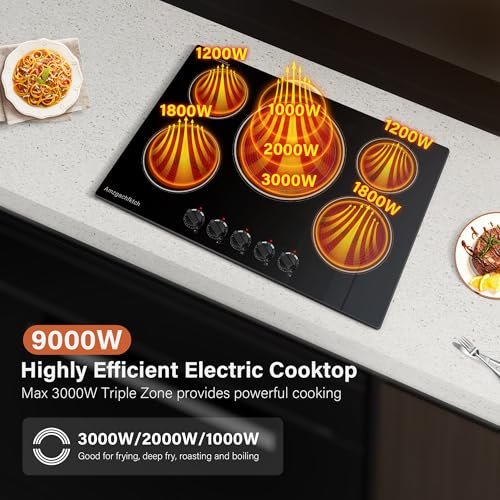
| Notable Burner Features | Triple-ring adaptive burner (1000W / 2000W / 3000W, fits 4"–12" cookware); turbo power boil element |
| Controls | Knob |
| Installation Type | Drop-in (built-in) |
| Safety Features | Hot surface indicator, automatic shut-off |
| Rating | 4.2 out of 5 stars (70 reviews) |
This cooktop is the right fit for a permanent 30-inch drop-in installation with an existing or new 240V circuit — buyers who need a portable or plug-in cooking surface should look at the Amzgachfktch propane or induction lines instead.
What to Confirm Before You Buy This Cooktop
The single most important thing to verify before ordering: this cooktop requires a 220–240V hardwired connection. There is no plug. If your kitchen has an existing 240V circuit from a previous electric range or cooktop, you're likely set. If you're replacing a gas cooktop or working from a kitchen that has never had an electric cooking surface, plan for a licensed electrician to run a new 240V circuit to the installation location. That's a real cost and timeline item — not something to discover after the cooktop arrives.
The second thing to verify is your countertop cutout. At 20.5 × 30.5 × 3 inches overall, the cooktop drops into a standard 30-inch cutout, but confirm your countertop depth and the cabinet clearance below the surface before ordering. The 3-inch depth dimension means you need adequate cabinet space underneath for heat dissipation — don't plan to run this above a fully sealed drawer with no airflow.
Once those two installation boxes are checked, the cooking-specific decision is simpler. Five burners at 9000W total gives you real zone flexibility:
- Triple-ring burner — the standout feature, scaling from a small inner ring up to a 12-inch outer ring across three power levels (1000W / 2000W / 3000W). This is the zone for large stockpots, a 12-inch skillet, or anything that needs even heat across a wide base.
- Turbo power boil element — highest single-zone output, designed for bringing large volumes of water to boil fast or maintaining a full rolling boil under a heavy pasta pot.
- Remaining three zones — standard radiant elements suited for sauces, side dishes, and anything that doesn't need max heat.
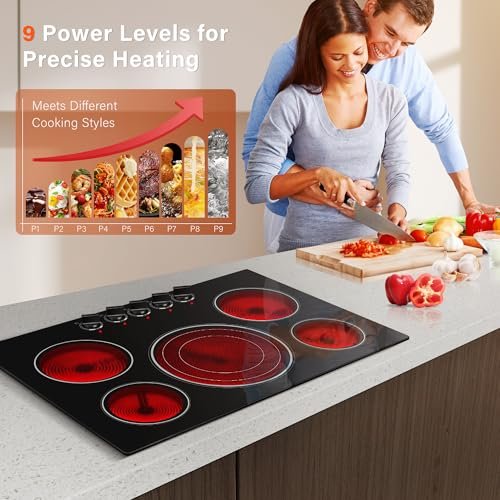
If your primary cooking concern is simmering delicate sauces at low heat, note that radiant electric cooktops as a category respond more slowly to power-level changes than induction. The knob controls here give you 9 or more power settings, which helps — but if instant, precise low-heat response is your top priority, the Amzgachfktch induction line is worth comparing directly.
Kitchens and Setups Where This Cooktop Fits
The drop-in installation format and 30-inch footprint make this a direct fit for the most common kitchen remodel scenario: replacing an existing 30-inch electric cooktop or the cooktop portion of a slide-in range. If you're keeping your existing oven and installing a separate cooktop, this drops into a standard countertop cutout without requiring a full cabinet rebuild. The black ceramic glass surface works in both white and dark kitchen designs without looking out of place.
This is not a portable unit. It's not the right choice for a rental apartment where you can't modify wiring, a food truck, a cabin without 240V service, or any setup that requires moving the cooktop between locations. For those situations, the Amzgachfktch propane gas cooktop or the plug-in induction unit is the more appropriate category. The 30-inch electric is specifically for permanent drop-in installation in a home kitchen with an existing or newly run 240V circuit.
Where it earns its place is in households that cook across multiple zones simultaneously — pasta water running on the turbo boil element while a sauce holds low on one radiant zone and vegetables sauté on a third. The five-burner layout means you're not cycling pots on and off a two-burner setup and managing timing around a missing burner. The electromagnetic radiation-free radiant design also matters for households that have avoided induction specifically because of concerns about electromagnetic output — radiant electric heats through infrared light, not an electromagnetic field.
Keeping the Ceramic Glass Surface in Good Shape
Ceramic glass cooktops scratch — that's true of this unit and every other brand at this price point and above. The surface is scratch-resistant, not scratch-proof. The practical rules: use a dedicated ceramic cooktop scraper for any food that bonds to the glass during cooking, and don't drag cast iron or carbon steel pans across the surface. Lift them. A pan that slides across ceramic glass even once can leave a mark that no cleaning product removes. This is a habit shift for cooks moving from gas grates, but it becomes automatic quickly.
For daily cleaning, a damp cloth after the surface cools handles most residue. For stuck-on spills, a ceramic cooktop cleaning cream and a non-abrasive pad are the right tools — avoid steel wool or any abrasive scrubber that would scratch the glass. The hot surface indicator takes care of the safety side of post-cooking cleanup: it stays lit as long as any zone is still warm enough to cause a burn, so you're not guessing whether it's safe to wipe down.
- Automatic shut-off — if a zone is left on without cookware or exceeds a heat threshold, the cooktop shuts down the element. This is a meaningful safety feature, not a gimmick, especially in kitchens where multiple people cook.
- Hot surface indicator — stays illuminated after cooking ends until the glass cools to a safe temperature. Don't bypass it by assuming the surface is cool because the knob is off.
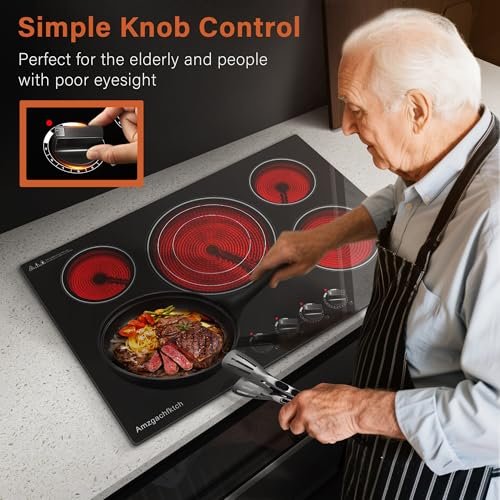
- Knob controls — the reason to prefer this over a touchscreen model is simple: wet hands, greasy fingers, and steam don't affect a physical knob. Touchscreen glass and active cooking don't always cooperate.
- Compatible cookware — radiant electric works with flat-bottomed pans across stainless steel, aluminum, cast iron, ceramic, and glass. Unlike induction, you don't need ferrous cookware. The triple-ring burner's adaptive zones mean you're not locked into one pan size on that element.
Frequently Asked Questions
Does this electric cooktop require an electrician to install?
Almost certainly yes. The cooktop runs on 220–240V and is hardwired directly to your electrical panel — there is no plug to simply insert into an outlet. If you're replacing an existing 240V electric cooktop, a qualified DIYer comfortable with hardwired appliances may be able to handle the connection, but local code in most jurisdictions requires a licensed electrician for new 240V circuit work. If you don't have an existing 240V circuit at the installation location, budget for both the electrician's labor and the cost of running a new circuit before you order.
What does the triple-ring burner actually do differently?
The triple-ring burner has three concentric heating rings that activate at different power levels — the innermost ring at 1000W for small pans, the middle ring at 2000W for medium cookware, and all three rings at 3000W for pans up to 12 inches across. This means a 6-inch saucepan gets heat concentrated under its actual base instead of wasting energy heating glass outside the pan's footprint. On a standard fixed-diameter element, a small pan on a large element loses efficiency and can heat unevenly at the edges. The adaptive scaling matters most when you're cooking across different pan sizes on the same burner across different sessions.
Does this cooktop work with cast iron, stainless steel, and regular pans?
Yes — radiant electric works with any flat-bottomed cookware regardless of whether it's magnetic or not. That includes cast iron, stainless steel, aluminum, ceramic-coated pans, and glass cookware with flat bases. This is the key difference from induction, which requires ferrous (magnetically responsive) cookware. The one rule that applies to all cookware on ceramic glass: lift pans rather than sliding them, especially cast iron, which is heavy enough to scratch the surface if dragged.
What does the automatic shut-off actually trigger on?
The automatic shut-off activates when a heating zone overheats — typically caused by a dry pan left on high heat, a burner running without cookware for an extended period, or a spill that causes rapid temperature fluctuation. It cuts power to that element to prevent damage to the glass surface and eliminate a potential hazard. The hot surface indicator remains on separately, telling you the glass is still warm even after an element shuts down. These are two independent safety systems — the shut-off cuts power to the element, and the indicator tells you the surface temperature hasn't dropped to a safe level yet.
Is 9000W total enough for five burners running simultaneously?
9000W is the total draw when all five zones run at maximum simultaneously — which is rarely how any cooktop gets used in practice. Most cooking scenarios have two or three zones active, with at least one running at medium or low rather than full power. The turbo boil element pulling maximum wattage while the other four run at moderate levels is a realistic heavy-use scenario, and 9000W handles that comfortably. Where buyers should pay attention is their home's panel capacity: confirm your circuit can support the 240V load before installation. A 40-amp or 50-amp dedicated circuit is typical for a 9000W cooktop — your electrician can confirm what your panel supports.